Stop Renting your Theology!
It’s time to see what the Bible actually says about sex.
You’ve heard the sermons. You’ve read the purity books. But have you ever looked at the original Greek and Hebrew for yourself? ONE Flesh is a 10-week deep dive designed to give you the scholarly tools to build a sexual ethic you can actually own.
Did God Really say THAT About Sex?
If you are deconstructing your faith, you probably have a “Trust Gap.” You don’t trust the simple answers anymore. You’ve been burned by mistranslations and cultural baggage masquerading as “Biblical Truth.”
You don’t need another guru telling you what to believe. You need primary sources.
I’m not here to persuade you. I want to give you the tools and resources you need to choose a way of life that brings together faith and sexuality in a way that is unique to you.
This isn’t a sermon series. It’s a university-level seminar. The ONE Flesh Bible study includes about 20 hours of verse-by-verse study of the Old Testament and New Testament seeking deeper understanding.
We aren’t going to skip the uncomfortable verses. We are going to wrestle with them—honestly, academically, and without fear.
For everyone who’s been hurt by what the Bible supposedly says about sex…
Unlearning shame. Reclaiming Scripture.
Because sacred texts shouldn’t silence your body.
What if the Bible isn’t a problem—just how we’ve been taught to read it?”
What if we’ve been reading it wrong…?

ONE Flesh is a 10-week online Bible study that treats sexuality as a sacred part of our humanity. My intention is to wrestle honestly and openly with controversial texts, presenting a diversity of interpretations without pretending the Bible is always easy—or always clear.
I don’t expect you to come to the same conclusions as I do and welcome your questions and ideas along the way. It is quite possible the writings of the Bible have a very different message than what any of us expect!
What We Will Cover
We are going back to the text to re-examine:
The “Clobber Passages”: What do Leviticus and Romans 1 actually say in their historical context?
The Keywords: A philological breakdown of Porneia, Lust, and Eros.
Marriage & Celibacy: Is marriage the only “moral” container for sex, or is that a cultural addition?
The Silence: Why does the Bible say so little about the things we fight about most (masturbation, dating, premarital sex)?
- The Bible and Sexuality
- Marriage and Celibacy
- Adultery and Divorce
- Masturbation and Pleasure
- The Real Purity Culture
- Nudity and Pornography
- Prostitution and Polyamory
- Gender and Sexual Orientation
- Porneia – Fornication, Premarital Sex
- ONE Flesh, The Mystery
Who is this for?
Christian leaders, scholars, & teachers seeking to re-integrate the scripture with the conversation of sexual ethics – in ways that are biblical, practical, and inclusive. I do my best to make this accessible for most adult learners, but it is designed with a heavy amount of biblical and academic rigor!
Key Assumption and Outcome
Practical tools and skills for reading and teaching the Bible on Sexuality
Why Study with Dr Kevin Jenson?
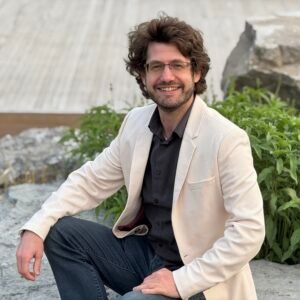
Bible Scholar & Sex Educator
I am not a pastor trying to keep you in line. I am a researcher trying to find the truth.
With a PhD and MDiv background, my loyalty is to the text, not a denomination. I approach scripture with the rigor of a scholar and the heart of a survivor.
My goal isn’t to tell you what your sexual ethic should be. It is to hand you the Greek and Hebrew keys so you can unlock the door yourself.
I dream of helping to heal the divide between God and Sex that has left so many people feeling disconnected from their bodies or from their creator. For those on a Christian journey, the Bible may contain a pathway of hope, beauty, and intimacy for human relationships, but right now such truth has been hidden beneath centuries of tradition (sometimes Christian) that vilified the body, desire, and especially sexuality.
In 2025, I began formal seminary training to develop my skills with biblical languages, historical context, and the evolution of theology so that I can offer a liberating perspective on sexual ethics across denominational lines.
I believe that no matter what their background of faith, individuals who are able to find a sense of wholeness and integration within themselves (which includes sexuality), will expand their capacity to cultivate a sense of wholeness in our broader society. For me, then, the dream of social justice is one that begins with the human body, with sexual healing as a spiritual practice.
Won’t you join me?